You can send an email: htkim@ultrasonic-washer.com


Ht Washer Equipment Focus on washing machine equipment solutions.


Views: 0 Author: Site Editor Publish Time: 2026-08-20 Origin: Site


Quick answer:
An ultrasonic cleaning machine uses high-frequency sound waves to generate microscopic bubbles that implode on contact with surfaces, removing contaminants from complex parts quickly and thoroughly. These systems are widely used in automotive, aerospace, medical, and electronics manufacturing for their speed, consistency, and ability to clean hard-to-reach areas without manual scrubbing.
Precision cleaning is one of those production steps that doesn't get much attention—until something goes wrong. A contaminated fuel injector. A medical instrument that fails sterilization. A circuit board with residue that causes a short. In manufacturing, cleanliness directly affects product quality, and getting it right consistently requires more than a brush and a bucket of solvent.
That's where industrial ultrasonic technology comes in. Across sectors ranging from automotive to semiconductors, manufacturers are replacing manual and chemical-heavy cleaning methods with systems that are faster, more thorough, and more repeatable. This post breaks down how these systems work, where they perform best, and what to look for when choosing one for your production line.
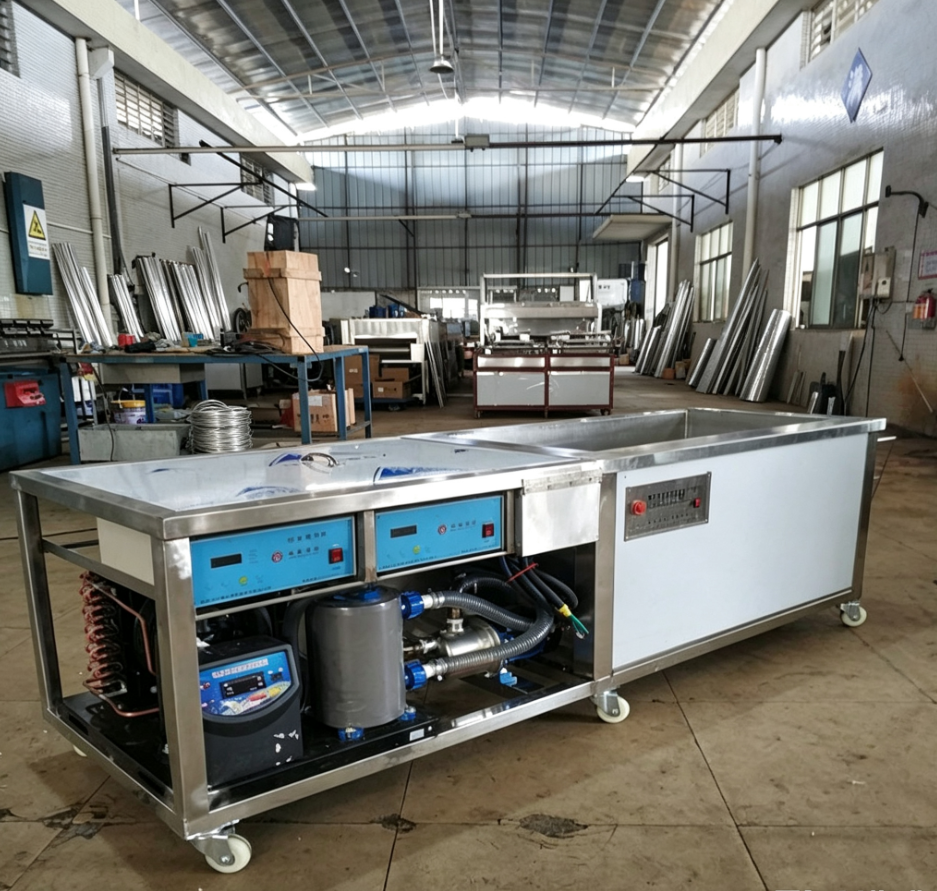
The core mechanism is cavitation. A transducer converts electrical energy into ultrasonic sound waves—typically between 20 kHz and 40 kHz—which travel through a liquid-filled tank. These waves create millions of microscopic bubbles per second. When those bubbles collapse near a surface, they release tiny, powerful jets of energy that dislodge contaminants from even the smallest crevices.
The result: parts come out clean on every surface, including internal channels, threads, and blind holes that manual cleaning simply cannot reach. The process is consistent from part to part, which makes it especially valuable for high-volume production environments.
Frequency selection matters more than many buyers realize. Lower frequencies (around 20–28 kHz) produce larger, more aggressive bubbles—suitable for heavy soils on robust metal parts. Higher frequencies (40 kHz and above) generate gentler cavitation, making them better suited for delicate components like optical lenses, semiconductor wafers, or precision instruments.
The technology is remarkably versatile. Below is a breakdown of common applications by industry:
Industry | Typical Parts Cleaned | Common Contaminants Removed |
|---|---|---|
Automotive | Engine blocks, fuel injectors, brake parts | Grease, carbon, metal shavings |
Aerospace | Turbine blades, hydraulic fittings | Oils, scale, oxide layers |
Medical / Dental | Surgical tools, implants, endoscopes | Blood, tissue, biofilm |
Electronics | PCBs, connectors, sensors | Flux residue, dust, oxidation |
Optics | Lenses, mirrors, prisms | Fingerprints, coatings, particles |
Jewelry | Rings, chains, watches | Polishing compounds, skin oils |
Each application may require different tank sizes, frequencies, temperatures, and cleaning chemistries. This is why selecting the right ultrasonic cleaning machine for your specific workload—rather than a one-size-fits-all model—makes a significant difference in output quality and operating costs.
Not all ultrasonic equipment is built to the same standard. Here are the factors that matter most in an industrial setting:
Tank capacity and configuration. Small benchtop units handle batches of small components. Large-scale production demands multi-tank conveyor systems or overhead-transfer designs that move parts automatically through pre-wash, ultrasonic cleaning, rinsing, and drying stages.
Power and frequency. Higher wattage handles larger loads and heavier contamination. Dual-frequency or variable-frequency systems offer flexibility across different part types.
Temperature control. Heating the cleaning solution (typically between 40°C and 70°C) accelerates cavitation efficiency and chemical activity. Look for precise, adjustable thermostatic control.
Material construction. SUS304 and SUS316 stainless steel tanks resist corrosion from cleaning agents and provide long service life in demanding environments.
Automation level. Semi-automatic systems work well for mid-volume operations. Fully automated lines with robotic transfer arms or conveyor mechanisms are better suited for continuous, high-output production.
A well-configured Ultrasonic Cleaner doesn't just clean faster—it reduces labor costs, minimizes chemical waste, and improves quality consistency across every production shift.
Jiangmen Hengtai Cleaning Equipment Co., Ltd. has built its reputation around solving real production problems. Operating from a 10,000 m² modern manufacturing facility in Guangdong, China, Hengtai designs and manufactures complete industrial cleaning and drying solutions—not just standalone tanks.
Hengtai's product range covers conveyor-type systems for continuous throughput, robotic arm configurations for automated part handling, hydrocarbon cleaning machines for solvent-based processes, and overhead-type systems for large or irregularly shaped components. Each system is engineered with energy efficiency and environmental compliance in mind, addressing increasingly strict regulations around solvent emissions and wastewater discharge.
What separates Hengtai from generic equipment suppliers is the emphasis on custom engineering. Production lines differ. Part geometries differ. Contamination profiles differ. Hengtai works with customers to specify the right frequency, chemistry, tank volume, transfer mechanism, and drying method for their exact application—then builds accordingly.
For manufacturers who need an integrated Ultrasonic Cleaning System that connects seamlessly with upstream and downstream production processes, Hengtai provides full-line design, installation support, and after-sales service.
The decision comes down to three core questions:
What are you cleaning, and how dirty is it? Heavy hydrocarbon contamination on large castings calls for a different setup than fine particle removal from delicate electronics.
What throughput do you need? Batch processing suits low-to-medium volume; inline conveyor systems are designed for continuous, high-volume production.
What are your downstream requirements? If parts go directly to coating, assembly, or sterile packaging, cleanliness standards will dictate system complexity.
Answering these questions with an equipment manufacturer—rather than trying to match off-the-shelf specs to your production line—consistently produces better outcomes and lower total cost of ownership.
Manual cleaning is slow, inconsistent, and labor-intensive. Solvent-based spray systems can be effective, but they raise environmental and safety concerns. Ultrasonic cleaning addresses both problems simultaneously: it cleans more thoroughly with less chemistry, less labor, and less variation between batches.
For manufacturers competing on quality and throughput, the return on investment typically comes from three directions—reduced rework and rejection rates, lower labor costs, and compliance with environmental standards that increasingly restrict solvent use.
Most metals, glass, ceramics, and hard plastics are compatible with ultrasonic cleaning. Soft or porous materials—such as rubber seals, certain plastics, and some surface coatings—may be damaged by cavitation. Always confirm material compatibility before processing.
The right cleaning agent depends on the contaminant and the part material. Aqueous alkaline solutions handle oils, greases, and biological soils. Acidic solutions target oxides and scale. Hydrocarbon solvents are used for parts that cannot tolerate water-based chemistry. Hengtai engineers can recommend appropriate chemistries based on your specific application.
Cycle time varies by contamination level, part geometry, and system configuration. In most industrial applications, a full cleaning cycle—including pre-wash, ultrasonic cleaning, rinsing, and drying—runs between 5 and 30 minutes per batch.
Yes. Conveyor-type and robotic-arm ultrasonic systems are specifically designed for continuous, high-volume production. These configurations process parts automatically without operator intervention between cycles.
Contact Hengtai directly at htkim@ultrasonic-washer.com. Their engineering team will assess your production requirements and recommend a tailored solution.
Ultrasonic cleaning technology has matured considerably. The systems available today are faster, more energy-efficient, and more adaptable than previous generations—and the manufacturers building them have decades of application knowledge to draw on.
If your current cleaning process is creating bottlenecks, quality issues, or compliance headaches, it's worth a conversation with a specialist. Hengtai's team at ultrasonic-washer.com offers free consultation and custom system design for industrial buyers worldwide.


