You can send an email: htkim@ultrasonic-washer.com


Ht Washer Equipment Focus on washing machine equipment solutions.


Views: 0 Author: Site Editor Publish Time: 2026-08-27 Origin: Site


Manufacturing tolerances keep getting tighter, and the parts moving through your production line demand cleaning that leaves no room for error. Oil residue, metal shavings, flux, and fine particulate can compromise a component long before it reaches assembly. That's why so many precision manufacturers are moving away from manual scrubbing and toward automated cleaning systems built for consistency.
This post looks at how ultrasonic cleaning technology delivers that consistency, where it fits into modern production, and what to consider before investing in a system. Along the way, you'll see how Jiangmen Hengtai Cleaning Equipment Co., Ltd. (Hengtai) approaches these challenges with one-stop, customizable solutions.
By the end, you'll have a clearer picture of whether this technology suits your parts, your throughput, and your budget.
Ultrasonic cleaning works through a process called cavitation. High-frequency sound waves travel through a liquid bath, creating millions of microscopic bubbles. These bubbles collapse against the surface of the part, generating tiny bursts of energy that lift away contaminants—even from blind holes, threads, and internal channels that a brush can never reach.
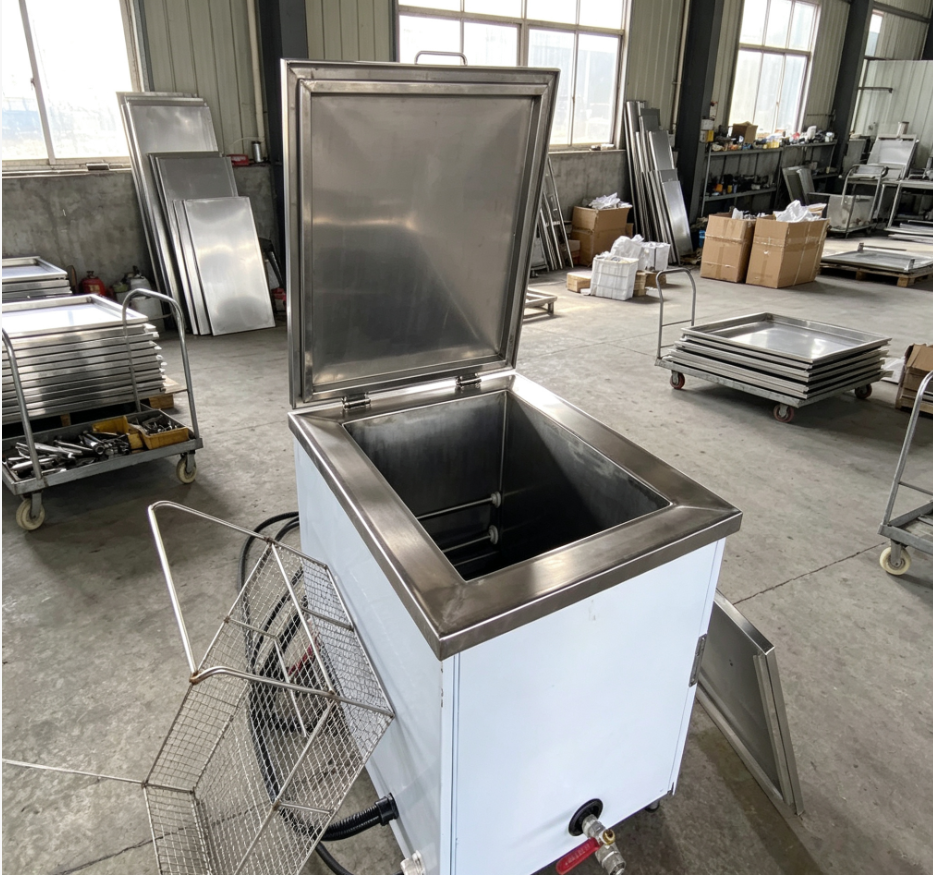
An Ultrasonic Parts Washer uses this principle to clean complex geometries without physical scrubbing. That matters for delicate components where surface scratching isn't an option. Common frequencies range from 28 kHz for heavy, stubborn residue to 40 kHz for finer, more detailed work.
Hengtai builds its cleaning systems around this science, offering both semi-automatic and fully automatic options depending on how much volume you need to process.
Cleaning is rarely a standalone step. It usually sits between machining and coating, plating, or final assembly. A poorly cleaned part can ruin everything that follows.
Here are some of the industries that rely on automated cleaning most heavily:
Industry | Typical Parts Cleaned | Main Contaminant Removed |
|---|---|---|
Automotive | Engine blocks, wheel rims, filters | Oil, carbon, metal shavings |
Electronics | Circuit boards, connectors | Flux, dust, fine particulate |
Medical | Surgical tools, implants | Biological residue, polishing compound |
Aerospace | Turbine components, fasteners | Grease, machining fluids |
Optics | Lenses, glass panels | Dust, fingerprints, coating residue |
Each application calls for different tank sizes, frequencies, and cleaning agents. Hengtai's engineering team designs equipment to match specific part types rather than forcing a one-size-fits-all machine onto a varied production line.
Flat surfaces present their own challenges. Glass sheets, solar panels, and display substrates need even coverage with zero streaking or micro-scratching. A general-purpose immersion tank isn't always the best tool for these jobs.
A dedicated Panel Cleaning Machine often combines brush rollers, high-pressure spray, and controlled drying to handle large flat items in a continuous, conveyor-fed process. This keeps throughput high while protecting the surface finish.
The choice comes down to your parts. Choose a spray or brush-roller system if you're cleaning large flat panels at volume. Stick with immersion ultrasonics if your components are small, three-dimensional, and full of hard-to-reach cavities.
Not every system is worth the investment. Before you commit, look closely at these factors:
Part complexity: Intricate geometries favor ultrasonic immersion; flat surfaces favor spray or brush systems.
Throughput: Fully automatic lines suit high-volume operations, while semi-automatic units work well for smaller batches.
Contaminant type: Heavy oils, biological residue, and fine dust each demand different cleaning agents and frequencies.
Energy and water use: Efficient systems lower operating costs and support environmental compliance.
Customization: A supplier that adapts equipment to your parts saves money over the long run.
Hengtai operates a 10,000㎡ facility with an in-house R&D team, which means the company can tailor tank dimensions, transducer configuration, and drying stages to fit your exact process.
The transducer is the heart of any ultrasonic system. It converts electrical energy into the mechanical vibrations that drive cavitation. Weak or poorly bonded transducers produce uneven cleaning and burn out faster.
A well-engineered Ultrasonic Transducer Assembly delivers stable output across the entire tank, so parts at the edges get cleaned as thoroughly as those in the center. Hengtai's submersible vibration plates use SUS304 and SUS316 stainless steel housings and support power ranges from 300W up to 2400W, making them adaptable to both compact tanks and large industrial baths.
Consistent transducer performance is what separates a machine that cleans reliably for years from one that needs constant repair.
Automated cleaning is no longer a luxury reserved for the highest-end factories. As tolerances tighten and quality expectations rise, reliable cleaning equipment has become a core part of staying competitive.
Hengtai focuses on solving cleaning, drying, and water-treatment problems as a single package—helping customers cut costs, improve product quality, and streamline production. If you're weighing your options, start by mapping your parts, contaminants, and volume, then talk to an engineering team that can build around those needs.
Ready to explore a solution tailored to your line? Reach out to Hengtai for expert advice and a custom equipment proposal.
Most cycles run between 3 and 15 minutes, depending on contaminant type and part complexity. Heavy oils and baked-on residue take longer than light dust or fingerprints.
Yes, though performance improves when the system is matched to a specific part range. Adjustable frequency and modular tank designs let a single machine handle a reasonable variety of components.
When the correct frequency and cleaning agent are used, ultrasonic cleaning is gentle enough for circuit boards and connectors. Higher frequencies around 40 kHz are typically preferred for sensitive electronics.
Routine tasks include filtering or changing the cleaning solution, inspecting transducer output, and checking heaters and pumps. Well-built systems require minimal downtime when serviced on schedule.


